‘The Forgotten Tryst’ : a poem and a call…

Waltzing Blue (Rakhi Varma)

I saw a dream, a wide-eyed one
Where the quiet inside begins to speak…
The rare vision that rouses you
From a much deeper sleep…

I saw a shining cup of victory, waiting
Suspended a moment above the din…
But, when the man did not come for his prize
Oddly, the cup made its way to him…!

I saw him enter the door and find the cup
Upon the mantlepiece, crestfallen…
Oh, how it struck his heart (and mine), the truth
That your road is always there and calling…

The dash that many a trepidation and fear
Made him refuse to run…
The track they knew so well, the cup and him –
Was always his, waiting to be won…

And stunned I watched in my mind’s eye
A promise unfold, but half a tryst…
A cup, a glory, yearning for its victor —
But oh! the experience of victory missed.

This poem and the piece are a bit different from the previous entries, in that they are a collaboration. A sudden vision that Shambhavi of The Little Space in Pune had, and a meaning that we both derived from it, forms this offering today. And we want to take you somewhere with it.

Imagine… You are busy doing something when a movie trailer starts playing on your screen. It immediately captivates you for some reason, so much so that you easily slip into watching it. Your interest is already piqued, so when the opening credits flash on, you read along as if on autopilot. And suddenly, it’s the mother of all surprises: It’s your name on the screen. YOU are the protagonist of this story… Yes. You scripted it and you are the director as well. And, now, know this that you laid it all out before you entered the stage, this very Earth “Theatre” to act it, live it and become it.

Call it incarnating. Call it ‘materializing’. Or simply being born. But when you made your entry here you forgot about having scripted your own movie, intentionally. Why? So that you could live it fully, ‘experience it’ from within, not without. To know every step and the whole road in advance would mean no desire, no momentum, no movement whatsoever. It would be the end before the adventure even began…

Thus, you give into this gorgeous amnesia. This beyond brilliant game of hide-n-seek. And you do not want to change anything because it has been so perfectly scripted by you in a co-creative process with Existence. For you are an intrinsic part of Existence, just as Existence is an extension of you. And together you play. You create movies (read stories), the rich experiences, all the learning and growth. And, as you go, you make better movies, slicker ones, expanding your consciousness to whatever it wants to ‘make possible’, and so on – till you find yourself flowing towards another creative endeavor elsewhere in existence, or to stop and take a break.

So where is the problem? …In disbelief.

We refuse to believe in the call of the soul, the only evidence that persists when all else is forgotten. That singular, most unique feeling of something tugging at the heart…relentlessly. You shrug it away, hide it, dampen it down for umpteen reasons. Imagine again: Everywhere, wherever you step, is the track laid down by you. Every dream you imagine coming true ‘someday’, thus, is the cup you gave to yourself in anticipation of that experience of victory. And all of it is waiting for you to trust in that slow recall that is termed ‘calling’ or ‘desire’ or ‘tug’, or ‘pull’… Have your word. But then you refuse to believe in your word…and you struggle and wither. Maybe, fall physically ill too. Life seems to hold no meaning. Why? Because the meaning your life has for you is in that calling that you won’t open yourself to. We live multiple lives when we watch movies, we even live for others, but we forget to live the most important life of them all – our own.

Through the Haze (Shubhangi Litoria)

Each time you let your own naysaying stop you from doing that which is only yours for the doing, it’s like creating glitches and disturbances in your smooth movie-watching experience. Life becomes jerky. Painful to watch. And, all those things that you stop yourself from doing will never get done by anyone else. Why? Because they were meant only for you to accomplish, to reach, to find. Your defeats are only meant for you for your learning, but then so are your victories only meant for you to take home. They will go to no one else. The whole process, that path you laid out for yourself to experience that bliss would self-destruct.

If  you don’t walk it, it is meant for no one else...

Rumi said, “What you seek is equally seeking you…” Indeed it is. Your creator self is seeking you. Your own masterful heart is seeking you. Your deepest and highest knowing is seeking you. And although this self-scripted drama is an illusion, it is THE path. It is designed to seem real for the sake of your play. You put in all of it to experience the whole magnitude of your own Being… And you got 3D glasses too – the depth of your feel to immerse yourself in it. In the quickening of the heartbeat when you set eyes on your soulmate, to feel the throes of a union, to sense the tears trickling down your cheeks when you win, to feel the vertigo as you look down the mountain top, and the pain of separation and death, and the deep acceptance of your human experience – as well as the remembering, the nirvana…the homecoming bliss!

For it all to come into experience, for it is empty without experience, you must participate. And to participate, you must believe. You must listen to that call. You must run for that cup that is already yours.

We hereby invite you to play in your orchestra, dance your ballet, embrace your lover, sing your song, run in your wild poppy fields, walk on your clouds, and kneel and kiss your ground…and though there are a thousand ways to do it, do it your way. 

Three Things

Breaking…Through (Rakhi Varma, 2021)

Some things are not meant
To be written down
But to be lit like lamps
In the room of the Soul
Where, alone, you go, sit
And cry tears of relief
At this gentle meeting
That comes like unexpected acceptance
From the one you loved so long.

Some knowing does not arrive on
Stallions of thunder
You might have imagined it
Like hers, or his, or like the legends
Of the so many Buddhas
But it also comes as if a single whisper rising
At the end of a great storm
Just to say, “Come”.

Some wars are not so that
You may win, or try to, or even lose…
They are meant for surrender…
When Draupadi raised her arms
Above all that could shame her
She went beyond shame
Forever.

The Haiku Moment

Two things, I have for you this time: Haiku, and a moment.

Haiku is a seventeen-syllabic poetic form of Japan that came into independent being in the 17th century. Every single Haiku, thus, is a really tiny poem of three lines.

And, a moment is all you and I ever have…

Reading and writing Haiku is like having a personal door into the great continuum of bliss. Much like other forms of moving or still meditation designed to snap one into a direct experience of being, Haiku breaks through the cloud of the moment to reveal many paths to that one destination. Great Zen masters are known to use Haiku to knock the disciple out of his compulsive affinity to thinking. For the “peace that passeth all understanding” needs not understanding, but intense awareness of the moment. And Haiku is the kind of poetry that is made up of the writer’s graceful presence in and to the moment. Pieces of Haiku are whole moments captured in words, together with their tremors of birth and their bliss-giving arrangements.

A lot of pleasure-seekers (don’t we all begin there!) miss the point of Haiku, because they are accustomed to looking linearly for a tale. Once upon a time…to what next…to happily ever after. Whereas, a Haiku is a vertical dive into the moment. There is no next. And that is the thrill of both a moment and a Haiku; you do not have to wait for the euphoria to greet you at some point along the story. It is ready and served. It is a meeting that is already in process. Come, it says. And you, if you have thankfully and brilliantly failed by now at finding meaning in horzontal pursuits, for failure is a must, you are free to step into this Haiku moment, just like The Fool of the Tarot hall of fame steps trustingly into the void.

To understand the ingredients of a Haiku, you have only to look to those moments of your life where you have felt a sudden surge of radiance fill your body-mind. Where your being seemed to have expanded out of the mental straitjacket it habitually wears… You will find that those experiences sprung literally out of and as a contradiction of feeling in your heart.

Overwhelming joy that made you cry.
Startling awareness, when you became aware of being the singular ‘you’, but within the paradox of being ‘all of it’.
Wonder, when on the wings of the commonplace came the magnificent.
Deep Love, when you, as another, became the other.
Utter silence, which surrounded you in the heart of utter chaos.
Courage, which rose on the shoulders of stone cold fear in your heart.

One could go on listing. And it would be a sublime list. But more sublime is the fact that it is in opposition that harmony arises. Two notes struck against each other, at their height, create that ‘moment’ which we term as a ‘glimpse’ of rare beauty. Is beauty rare, though? No, obviously not. But we aren’t there at her feet constantly to know her presence her at all times.  

And that is what each Haiku is. An ever-extended invitation into beauty. An exquisite contradiction of feeling captured in seventeen syllables, set into three lines of 5-7-5 each. Further, to be able to capture the contradiction so necessary for the experience of the moment, Haiku has two ingenious rules. One, there has to be a ‘kireji’, a cutting (contradicting/contrasting) word. Two, a ‘kigo’, which is a seasonal reference, for what else would we dive into if not the flowing seasons from which moments spring forth? Thus, you are lulled in, and disarmed, mind you, by the first phrase depicting beauty. Next comes the cut-word, hidden amongst the grammar, which then takes you to the gorgeous experience hidden in the last phrase, crashing through a wall. The wall of your mind.

Portrait of Matuso Basho (Hokusai, Late 18th century)

For a writer to not only be able to write Haiku, but to be able to convey that kind of a satori-like effect, he has to exist in an intense Zen awareness himself. But to convey that impact, are seventeen syllables enough? To express an ‘unspeakable’ moment? Yes, if you think about it. It is not only essential for Haiku to be short, but the fact is that this is the only way. Sparks wouldn’t be sparks if they lasted. They would become rambling stories, and, again, linear. And then they wouldn’t pull us into ‘out of the blue’. It is so scientific a format for capturing something so fluid that, it seems, it could only have been intuited.

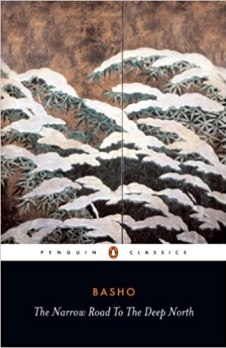
The four masters of Haiku, known as the “The Great Four”, are Matsuo Basho, Kobayashi Issa, Masaoka Shiki, and Yosa Buson. It is to them the students of Haiku turn to grasp the way. The first and the most sublime of them all, Matsuo Basho of the Edo period of Japan, travelled far and wide and often disappeared into the wilderness of the north to catch the fleeting light of the moments of plain rural life. The following Haiku are seeds fallen from his traveling sack, poitnig us to the path. You can enjoy them unaware, and find something growing on you much after it is all over, or you can open your eyes and look around into them as an initiate would, and find your own dirt paths.

Basho writes:

"It's not like anything they compare it to 
-the summer moon."

It is only when the mind tries to compare that true beauty escapes comparison, thus becoming unparalleled. The mind’s helplessness gives birth to wonder.

"In Kyoto
Hearing the cuckoo's cry
I long for Kyoto…"

This urge, which only seems mad because the poet is in Kyoto and is longing for it too, is an urge for the essence of Kyoto – the scent, which can never be possessed. Hence, the longing. The cuckoo’s cry is perhaps the poet’s cry too. It is the poet’s longing for his own essence, clear of the wandering mind… Like a wave yearning for the ocean. These are all mirrors. All paths.

"Scent of chrysanthemums…
And in Nara
All the ancient Buddhas."

The ancient and the present, held together in one moment. Also, the wisdom of the Buddhas likened to the scent of chrysanthemums. Something so fleeting, wrapped in a moment. And yet, a continuum, like every flowing moment.

“A honeybee
Staggers
Out of the peony.”

Staggers… A word indicating loss of control. An unhinging. Feet that cannot bear the beauty of the fullness received. Thus sated, the bee leaves the peony flower, just as a drunken lover leaves a tavern or a disciple leaves the master, having partaken of bliss. The moment is the peony. Bliss is in the staggering out. You and I are the bee, leaving the tavern full and mindless in the most poetic, as well as literal sense. And the nectar is the essence of us all, and of this meeting.

This is what Haiku does. It takes you into a timeless presence. All you need to do is to be there at that edge of the moment, awake. And reading Basho is to slip knowingly to that edge…where moments don’t stand out, but turn into a river of awareness. And it is a life-skill. To be able to merge with your own direction, instead of being hurled about by circumstance, is grace.

To this grace, to this dazzling way of Haiku, we kneel and kiss the ground.