The Preferred Rebellion

In these times of rippling uncertainty, when all seems to be afloat in the great sea of the unknown, I have for you the only ground of surety there ever was: This expanding moment, and the energy inside it.

A moment is all you have at any given point in your experience. It is where you always actually are, no matter where the mind maybe. When entirely in sync with that energy, it is where you feel so deeply alive so as to need nothing further. No assurance, no ambition, no security. I see it. And I have been seeing it for some years now, and so have you, but we let the knowing slip because we have been taught otherwise. (Teaching is the biggest, most fragile responsibility, I realise.)

Wooden Voices (Desh Deepak, 1980)

And that ‘otherwise’ is the dictum to keep your eyes on the future, not in the present. And, thus, to make an extraordinary and unnatural effort to ‘exist’, but not here, not now… It always felt like a double bind. Like adding legs to a snake (which already has a different way of moving!). Like turning around to catch your shadow. Like tying your bootlaces together so as to be steady.

For how does one ‘work at it; and not ‘be’ it? Existing, I mean.

On day one of your semi-maturity, you were let into the serious secret that life is a struggle. Not only were you expected to accept it, but to go on wisely without ‘wasting time’ to amass skills in order to amass wealth to, ultimately, at the end of your creative years, find a shred of happiness. Perhaps in the form of a sailboat or a fancy house, or a cottage in the hills… And when you realised that you have been cheated out of your bliss, because there was really no need to go at it in such a roundabout manner, you were told that you cannot have it all.

Thus, we plan and prepare, wait and anticipate, build and climb our mountains, or else retrospect, regret and repair, so that everything we do is designed to push away the living moment. Waves of bliss rise and crash against the rocks of our folly. And the opening available in the moment continues to sink below the shores of consciousness.

And how did our civilization get here, I ask for the umpteenth time, befuddled. And why? It seems that the obsession with the future is just fear in operation: Fear of death and for survival, both of the ego and of its carrier, this physical being. All the preparation, and the expectation that always rises entwined with it like a serpent, is nothing but a grand miscalculation made in the interest of mere continuance. And that is how we were wasted, not time, as we learned to be at war with our own natural presence.

Do you see that the fight now is against our own DNA still carrying and processing the wrong information? And now, when the accumulated fear has come to pass, we-the-half-living, the schizophrenoids, need to turn to methods, to meditation, to self-help literature, to psychiatry, to ayahuasca, to yoga and tantra, to what have you, so as to help the conscious and subconscious make peace with each other?! I turn around to look for someone to yell at. Someone whom I can give an earful. But there is either nobody, or this whole.

So then, am I despairing? I am. I am despairing and angry, for look what our structures of conditioning have brought us to. And yet…when things gets so bad they create conditions for a breakthrough. For, look, we now have the right key. We are being reoriented, correctly at long last.

And it is not as if we did not have the right directions before. But so often were the visionaries and poets and artists badgered. So often the Sufis and mystics and prophets and alchemists pushed to the fringe. So often the natives everywhere were rubbished and removed. So that even though they went pointing to the moon, our monolithic, self-obsessed and self-propagating rational fear built a wall around it. A scientific wall. A reasoned wall. A political wall. A cultural wall. A method wall. A money wall. Another and yet another…and with such lightening speed we built (for the speediest thing is the mind) that we hurtled further and further away from the door in the moment. It is as if we boarded a train that would never stop going away. If it did, it would explode in our heads.

The Answer (Rakhi Varma)

But now, we have been made to stop. And how. And I celebrate it. The walls around the moon are crumbling. And I feel tremors of life in my heart. Reason has cracks in it and compassion glimmers on blades of grass all over the Earth. And now I am born. There is huge hum of returning to natural farming, of sustainable living, of restoring ancient wisdom, of reining in not just our use of plastic, but blind desire itself. Finally, there is real work to do. Birds and animals, forests and rivers and mountains are walking into the center of our days and hours. And I begin to find love flowing through my veins hitherto dulled by homogenization. The values ascribed to ‘the market’ are up in the air and we are thinking of gift and gratitude once again. There are crashing sounds in the newspaper everyday. And the gap, the limbo has brought us rest. All the lives that we collectively lost have turned into messages of another way of being.

If we do it right this time, for there were opportunities many other times in history, we can begin to live a full and natural existence. We wanted this experience, isn’t that why we are here? And even if we cannot stop thinking, we can at least think right. If we are still confused and angry, we can also be inspired. This chaotic energy is good at last. This is the preferred rebellion, as opposed to the ordered one against our very own presence. So, I am clamoring and raising an energetic din wherever I am to drown out the voice of conditioning, whether inside me, or outside. And I ask you to join in.

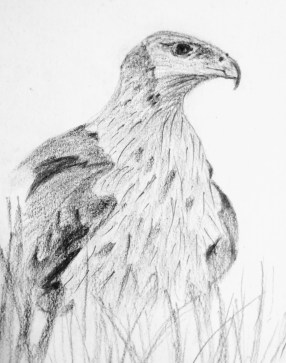
As news flashes across changing screens and evening prayers sound out in temples, churches and mosques, the quiet sky reflects shifting patterns of light in a moment. A koel continues to sing deeply into the darkening evening. What prayer is that? The last bright orange of the sky is soon going to be no more. An eagle enters it in this split between being it and wanting it, and soars… And, here, I stand at the same window, which only yesterday looked out into the future. I am here in this moment now, full of rejoicing. And you are invited. Will you come? For once, let us do this together. We must walk back into the present and kiss the ground…and make home here. Not in fear. Not in the future. Not in conditioned happiness. But right here, in the watershed this moment is.

‘Pomegranate…’ a poem

Red Noon (Rakhi Varma)

I have never told you
My dears, never but now–
That I want to see you
Ripped apart
Like sudden halves of a pomegranate
And see the stunning red truth of you
Be revealed even to you
In the sunlight striking the bowl
Of this world…


For I have met your soul
Even when you hid it
In plain sight
In your house of things
Believing that the doll house was
All there was to do…
I saw through the peek-a-boo
And through your arrangements
Of immense pleasure and pain
And of how hard you try
To maintain the equilibrium between
Throwing a party and
Touching the soul of your child…
Between following the clock
Until the house has slept
And returning then alone
To your precious solitude…


But a moment have you, before
another sleep and another
Overtakes your glorious fire!
You with your riches and you
With your fearful legacy and plans
Is that all you will give yourself
And not your own full audacity?
Decking your boat with gossamer flowers
While the whole ocean moans for you–
Is there a greater poverty?


Come, I say, spread out your finest silk
Made of the throbbings of your being
And wear it everywhere unabashedly…
For once sit still without an answer
Or books or eloquence or curtains
And let it all turn into the field
Where you still run wild
Both arms flailing apart in freedom
Enveloping the entire sky–
Stopping, listening, waiting
Expecting any moment
To greet in tears of joy
Your other forgotten self.

-Rakhi Varma

Vesper Flights by Helen Macdonald

Helen Macdonald’s Vesper Flights is a beautiful and vibrant collection of essays about many different things, and yet it is all stitched together by one desire, one urge: To expand our understanding of this existence we call home. It is a naturalist’s unbridled gaze into every bird, animal, haunt, star, and landscape she comes across, making it seem as though you are looking at and hearing of these things for the very first time. Some very vital themes run through this book, which make simple connections where none seem possible, propping up a possibility of solutions. For what is a solution if not an entirely fresh and unseen perspective…?

Looking through a child’s eyes, Macdonald starts off with looking for the meanings a nest, a haunt, a perch, a space may hold — and the human connection to it all. It is a thread that appears and reappears throughout the book, weaving together in its subtext unexpected stories.

“These days I wonder about how they seem to be one kind of entity when they contains eggs and a different kind of entity when they contain chicks. How nests and eggs are good things to think about when considering matters of individuality, and the concepts of same and different, and a series. How the form of the nest is a phenotype of a particular bird species, but how local conditions foster beautiful idiosyncrasies. How we humans are intrigued when birds make nests out of things that belong to us: house finches lining their nests with cigarette butts, nests of Bullock’s orioles fashioned from twine, kites decorating their tree platforms with underwear stolen from washing lines. A friend of mine found a ferruginous hawk’s nest wrought almost entirely from lengths of wire. It’s satisfying to consider the incorporation of human detritus into the creation of birds, but it is troubling too. What have they made out of what we have made of this world?

It is the same conflict between vulnerability and strength, and the loss of home and habitat, which she explores further in The Student’s Tale–the story of a human refugee, an asylum seeker, whose place in the world is lost to war, intolerance and mindlessness. Between those two essays, she traverses and closes the artificial difference between one precious form of life and another, with what can be termed as ‘a true love of existence’.

Proud (Zahir, 1995)

Vesper Flights is a book not with one main door but with endless windows, entering through which you find yourself returning to the knowledge that there is brilliance and intelligence beyond the human one–which forms another theme. The pages are filled with diverse and spectacular accounts of other life forms, away from our self-centered meanings and free unto their own: There are swifts who sleep high up in the air, pulled by a rhythm of their own; falcons and rooks who look down at us from their own free perspective; deer who exist not only in their magical appeal to us, but in flesh and bone reality; there are moving murmurations, vast flocks of birds rising together as if in mathematical symphony, and how, then, they disperse into individual birds with hearts and needs and life; forests that have meaning not only in our urge to find peace in them, but that exist as bodies independent and apart from us. Across the essays one realizes the stark narrowness of even our love for the wild—we still behave as though we are their keepers, protectors, savers or even worshippers. But Macdonald persists in driving in the salient truth that man is simply ‘the other co-habitant of this world’ to the forest, to the beast, to the bird. And that there are as many kinds of knowing as they are species here. She brings to us “…the realisation that there is a particular form of intelligence in the world that is boar-intelligence, boar sentience. And being considered by a mind that is not human forces you to reconsider the limits of your own…”

Opening yet another facet in this bioscope, she gives a fascinating account about “a towering column of flying ants” out on their nuptial flight, and the herring gulls out to feast on them.

“It isn’t merely the wheeling flock of birds that transfixes me,”, she says, “or the magic of how the ants have carved out a discrete piece of unremarkable air and given it drama and meaning. It is that motive power behind this grand spectacle is entirely visible. The vast stretch of sky, the gulls, the imperceptible ants, is a working revelation of the interrelation of different scales of existence, and it is at once exhilarating and humbling.”

Natural sovereignty. Individual and group intelligence. The scales of existence. The dimensions. The surfaces. The waves. Vesper Flights opens your heart to a dance of brilliant asymmetry with the symmetry of meaning embedded within ‘life’ and its diverse forms. Just when you find yourself looking differently at the forests, you are thrown up in the sky on the shoulders of the Empire State Building in Manhattan, in the gross heart of modernity, a most startling contrast. There, Macdonald introduces you to “…a wildlife phenomenon that twice a year sweeps almost unseen above the city: the seasonal night flights of migrating birds.

“Through the lenses, birds invisible to the naked eye swim into view, and there are birds above them, and birds higher still. …For every large bird I see, thirty or more songbirds pass over. They are very small. Watching their passage is almost too moving to bear. They resemble stars, embers, slow tracer fire. Even through binoculars those at higher altitudes are tiny, ghostly points of light. I know that they have loose-clenched toes tucked to their chests, bright eyes, thin bones and a will to fly north that pulls them onward night after night. …Something tugs at my heart. I’ll never see any of these birds again. If I weren’t this high, and the birds weren’t briefly illuminated by this column of light cast by a building thrown up through the depression years to celebrate earthly power and capital confidence, I’d have never seen them at all.”

It is both astonishing for the human mind to enter this disparate tie of cityscape and nature–and inescapably necessary. For, our beautifully illuminated cities mean grave danger for these creatures passing overhead at night. Disoriented and confused by a dazzle of light at a time when they need darkness for their navigational machinery to function at its best, they either die or, flying about in spirals, drop down exhausted. In a most poetic effort to revive our link with the natural world, Macdonald suggests: “High-rise buildings, symbols of mastery over nature, can work as bridges towards a more complete understanding of the natural world – stitching the sky to the ground, nature to the city…” For a bird is still as exquisite a life when perched on an electric pole as when it is found dashing through a grove of trees. If you connect with that life, the landscape will transform all on its own. Thus, Macdonald continues to connect the pieces of our broken giant of a world together, the ‘industrial and urban and abandoned site and old factory’ parts of us in a bid to reclaim our connection with the unputdownable life in all those pieces. Her experience at a power station in Dublin, changes forever our relationship with it all:

The Peregrine (Rakhi Varma, 2017)

“…The Poolbeg site is about as far as you can get from a thriving natural ecosystem, but the act of watching a falcon chase its prey above the scarred and broken ground below feels like quiet resistance against despair. Matters of life and death and a sense of our place in the world tied fast together in a shiver of wings across a scrap of winter sky.”

The backdrop of the essays keeps changing like in a spectacular stage-play, and yet we are driven by a single-minded urge towards that one immense field of wonder, where you are filled with a new-found sensitivity towards everything. Every essay is a journey you take inside and out, and everywhere, all at the same time. You are on Earth and yet you are in the midst of what life may have been on Mars billions of years ago. You are in a city but, at within the same span of being, there are volcanic lakes, salt fields, high geothermal sites and the “extremophile life” pulsating in them, living in accordance to rules that bend and break your defined ways of knowing, that stretch and twist your customs to make space for the irregular. Again and again, you find that you are not alone. That your experience may be personal, but it is shared by numerous others. This breaking away and coming together, traversing the blimp between physical reality and the spiritual, is the joyride.

Thus, Vesper Flights is not just a book but a method, a means to free yourself to experience this impossible level of connection. We leave you with this last passage from the essay, Eclipse, which is the perfect end to make another crack in the way we perceive and therefore, feel.

“I check the sun again through my eclipse glasses. All that is left now is a bare, fingernail curve of light. The landscape is insistently alien: short, midday shadows in a saturated world. The land is orange. The sea is purple. Venus has appeared in the sky, quite high, up to the right. And then, with a chorus of cheer and whistles and applause, I stare at the sky as the sun slides away, and the day does too, and impossibly, impossibly above us is a stretch of black, soft black sky and a hole in the middle of it. A round hole, darker than anything you’ve ever seen, fringed with an intensely soft ring of white fire. Applause crackles and ripples across the dunes. My throat is stopped. My eyes fill with tears. Goodbye intellectual apprehension. Hello, something else entirely. Totality is so incomprehensible to your mental machinery that your physical response becomes hugely apparent. You cannot grasp any of this. Your intellect cannot grasp any of this.”

To this great variety of the known and that which can be known, and to this endless way of knowing the unknown, we kneel and kiss the ground.